Smore, Lino, and Remind are highly
effective methods of delivering important course information to both
parents and students. For this quest, I created a weekly newsletter
using Smore. I also created a Lino sticky to be posted on the course
homepage bulletin board. Additionally, I will be sending Remind
messages with the due dates for each assignment.
Wednesday, March 18, 2015
3.2.1 The Newsletter Quest
Newsletters play a very important role
in virtual instruction programs. It is a creative and engaging way
to ensure ongoing communication with all the stakeholders. Because
of the virtual nature of online learning, continued communication
regarding academic expectations and due dates becomes key to ensure
students' success.
Monday, March 16, 2015
3.1.2 News Quest
![]() |
| |
As an online instructor, I find it
vital to incorporate news items and announcements in a variety of
ways, from the most traditional ones such as email and the news
forum, to more interactive tools that include animation and audio.
The goal is to reach every student and to capitalize in their
particular learning styles to make the online-learning experience as
successful and meaningful as possible.
The following is a Voki that I created
to complement and redeliver an important message posted on the
homepage bulletin board.
Sunday, March 15, 2015
Saturday, March 14, 2015
2.1.3 Ongoing Communication
![]() |
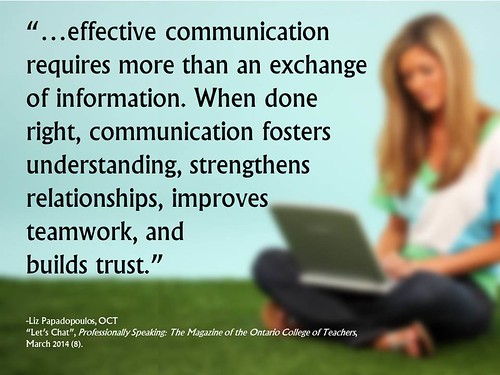
Undoubtedly, effective communication remains an essential part of online instruction. Since all student-teacher interaction takes place virtually, it becomes imperative that teachers use as many Web 2.0 tools as possible not only to individualize instruction, but also to communicate effectively. Unlike the learning environment in a brick-and-mortal school, virtual learning requires from the instructor a high level of responsiveness when communicating with both students and parents. Emails and phone calls should be returned within 24 hours to provide students the assistance that they need. Also, parents' inquiries should be addressed immediately in order to give them a stronger sense of connection and involvement in their child's education.
|
An example of an ongoing communication
that could be sent to all stakeholders.
|
Friday, March 13, 2015
2.1.2 Communication Guidelines
![]() |
| |
Communication Plan Outline
- Welcome email:
- Course name
- Welcome message (my contact information and office hours)
- Information concerning the date and time of the synchronous Welcome Session
- Instructions concerning course access
- Instructions accessing Course Schedules and Course Syllabi
- Expectations
- Individual phone call to each student welcoming him or her to the program and class:
- Conference with the parent
- Verification that all contact information, including emails and phone numbers are accurate
- Personal notes versus mass communication to stakeholders:
- Individualized performance feedback will be communicated to students, parents, and schools through personal notes.
- Mass communication to stakeholders will be exclusively used for general announcements and updates.
- Stakeholders:
- Daily communication with students
- Bi-weekly progress report sent to parents and base school
- Automatic missing assignment/behind pace report sent to parents and base school
- Brag notes sent regularly to all stakeholders
- School Policies regarding Communication:
- These policies will be followed and all contact will be documented for future reference regarding student performance, special needs, and/or academic issues.
- All administrative team members will be informed about student concerns, academic violations, or parental issues as determined by the program’s policy for communication.
- Tools available for effective Communication: The “News” forum, Lino stickies, email, phone, Blackboard Collaborate, Skype, Remind 101, DialMyCalls.
Thursday, March 12, 2015
2.1.1 Identify Stakeholders Quest
![]() |
| |
The descriptions of the stakeholders'
roles provided for this quest do correlate to my perception of the
responsibilities that each stakeholder must assume in successful
online learning. Regarding the role of the online instructor, I
would add that establishing a great rapport with online students from
the beginning of the course is very important. One way to do this is
to send an opening email in a welcoming and encouraging tone.
Another effective communication strategy is to post frequent
announcements and updates with due dates to help students get used to
the pace of the course. Timely and personal feedback is also
critical to ensure students' success.
Concerning the online student's role, I
like the idea of releasing responsibility and empowering students to
take charge of their own learning. The virtual classroom provides
great flexibility for both students and teachers to create a
technology-rich learning environment that promotes student motivation
and fosters student engagement. In my online classes, I structure
communication so it is not just two way (me and each individual
student). Since often times other students can relate to the
questions better than I can, I encourage student responses to Help
Forums and I just monitor to ensure accuracy in answers.
One of the stakeholders that was not
explicitly mentioned in this quest is the school counselor. School
counselors play a key role in the successful completion of online
courses. From the initial recommendation for a student to take a
course, to the follow-up process as well as the scheduling and
facilitation of the final exam, school counselors are that additional
support necessary to ensure that students are successful in the
online environment.
Tuesday, March 10, 2015
1.1.2 Laws of Communication
![]() |
- When students are assigned to post information to public social media platforms outside of the school LMS, they should be informed that their material may be viewed by others.
- Students should not be required to release personal information on a public site.
- Instructor comments or grades on student material should not be made public.
- While not clearly required by law, students under the age of 18 should get their parent’s consent to post public work.
Regarding copyright laws and online
learning, the method that will more likely ensure that copyright is
not being violated is to avoid copying any content from the Internet.
Most works on the Internet are copyrighted, even if there is no
explicit indication. This doesn't mean that copyright requires that
all work, images, words, and graphics must be original. Fair use
laws allow us to use portions of copyrighted materials as long as we
respect the legal boundaries of such fair use.
References
Orlando, J. (2011) FERPA and Social
Media. Retrieved March 10, 2015, from
http://www.facultyfocus.com/articles/teaching-with-technology-articles/ferpa-and-social-media/#sthash.FiahAz4B.dpuf
Subscribe to:
Posts (Atom)